by Kent Brittan
Approaches Towards Globalization
Globalization means many things to many people. Governments around the world have worked hard to reduce or eliminate foreign exchange controls and tariffs to create large regional free-trading zones only to see their work overwhelmed by a “global trading block” over which they exercise little to no control and try to react with few tools left to them. Individuals enjoy the wider array of low cost goods now available, while fearing the eventual impact on their jobs.
IBM’s
Bob Moffat sees globalization as worldwide integration:
“There’s no doubt globalization is the buzzword of our time. The term is used in so many contexts for so many different purposes I would be hard-pressed to say that the media — or anybody else — has missed a key aspect of it. That said, globalization is too often portrayed as an either/or debate; something that you have to be for or against; think is good or bad. It can be — has been — a very polarizing topic. There are some who say Globalization is all about ramping up low-cost operations in emerging countries while winding down operations in mature markets. And there are others who see it as the panacea for global prosperity. I have a different view. Globalization is the ability to assemble the right skills, in the right place, at the right cost — and being able to harness them along with your experience and expertise on behalf of your clients. In this sense, it’s a more a matter of global integration.”
Mike Eskewdescribes the UPS journey:”Anticipating the global economy of the 21st century, UPS in the late l990s transformed its own business mission from that of a package delivery company to one that synchronizes global commerce for its customers. UPS has acquired and aligned new supply chain resources and emerging technology applications to match customers’ global economy needs for synchronized supply chain, business process and export solutions.”
“UPS’s commitment to China reflects that approach. As China began to welcome foreign direct investment, UPS not only expanded its air package and freight network in Asia and China, but also its China logistics resource capabilities. UPS is also helping Western companies to take advantage of China and other developing nations’ expanding middle class consumer markets with technology solutions that simplify exporting.”
Keith Nosbuschoutlines Rockwell Automation’s progressive approach:”The way we look at globalization as a company has evolved. First, we expanded sales outside of the U.S. by opening sales offices, expanding support and providing some documentation in local languages. We began to leverage our global buying power allowing us to source for best of breed services and products. We then began to identify premier manufacturing locations and capabilities around the world so that we could improve the ability to deliver a product when the customer wanted it to anywhere in the world.”
“Today we are focused on proximity to the customer so we can offer our full range of business products and services where the customer is located, from sales and support, to manufacturing, engineering and marketing. We are locating the business management and strategic decision-makers near the customer.”When we talk about the globalization of business it is important to recognize first of all that for many companies this is nothing new. Large corporations have been operating on a global basis for years, if not decades. What is new are the breaking down of many of the barriers to the free movement of goods and services, the information technology revolution, the creation of regional trading blocks in Europe and North America, worldwide sourcing, and the opening of China, Russia and Central Europe to economic integration with the Western economies. This has dramatically increased the scale of international trade by quantum leaps over the past two decades. The large multinational, or more appropriately, “global” companies, for which the cost and difficulty–both financial and managerial–of entering the new markets is relatively low, have been quick to seize upon the growth opportunities created by these events. These companies have also discovered and developed new low cost sources of supply, by building their own factories in low cost sources, enabling the transfer of existing suppliers, or by simply developing new relationships in the new markets and thereby dramatically improving their cost structure and competitiveness.
While sales and marketing growth in newly opened markets is very opportunistic and easy to understand, globalization of supply at the corporate level is not something haphazard. Many people make the mistake of assuming that the globalization of supply is equally opportunistic and equivalent to the much-maligned word “outsourcing”. In fact, outsourcing is only one part of an enterprise-wide operations strategy. This can be better explained graphically in the simple decision-tree diagram shown below:
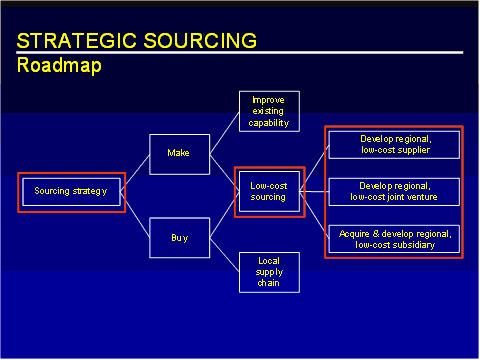
The process begins with the fact that many companies today are re-examining all of their operations from top to bottom to decide what they are really good at from a cost and operational viewpoint or where proprietary or critical technology is involved. This analysis can run the gamut from production parts to an in-house print shop. If done properly, this core/non-core study of products, part families, services and functions generally leads to the conclusion that many things currently performed in-house would be better performed by the supply base.
If the decision is to “buy” rather than “make”, the next step is to go through a step-by-step sourcing process to determine where to obtain the product or service. Often this simply results in moving production to an existing supplier down the street. In today’s global world, however, it could be that obtaining certain components or services offshore is the best solution. This leads to another decision point as to whether to set up a wholly-owned subsidiary overseas, a joint-venture, or simply to buy the product/service from a third party. The point here is that for most companies outsourcing is, in fact, one result of an overall analytical process to determine the correct operational and procurement strategy, and not an end in itself.When the core/non-core analytical process leads to the decision to move production or services offshore, it should not be taken lightly. Companies have manufacturing quality controls, IT and engineering standards, environmental requirements, communications protocols, confidentiality rules, etc. that must be respected wherever they operate. Moving to a new country or a new supplier usually requires substantial support from the home country, both for those things sent to a wholly-owned subsidiary or outsourced to a third party. This support adds significant costs that must be factored into to the financial equation about whether or not to move activities to an outside source. This is why companies often prefer to transfer them, wherever possible, using their existing supply base.
Companies are not moving to China just for low-cost sourcing for export, but also to access the huge and growing local market for almost everything. Thus, if the ABC Company builds a new factory in China, it could be both to expor
t from China and to serve the Chinese market. This is true not just for major corporations and not just in China but for smaller firms and other global markets as well. ABC might also be generating increased exports from the United States around the globe thanks to lower costs on the series of part numbers sourced in China. It is easy to understand how the net impacts of these investments and transfers of production soon become very difficult to calculate, especially when aggregated at the national or world-wide level.
Bob Moffat describes the IBM approach:”Globalization is changing the fundamental model for how businesses shape strategy, management and operations in a truly global way. It is creating the capacity to assemble and deploy global capabilities faster . . . more efficiently and effectively. At IBM, we call this new model the globally integrated enterprise. This kind of enterprise locates operations and functions anywhere in the world based on the right cost, the right skills, and the right business environment; and it integrates those operations horizontally and globally.”
“For example, at IBM, we used to have separate supply chains in different markets, now we have one supply chain — a global one — for the entire company. In our professional services businesses, where we used to think about our human capital — our people — in terms of countries and regions and business units — we now manage and deploy them as one global asset. If you apply that same logic to all the operations of a company… from R&D and finance, to manufacturing and logistics — you begin to see how different this globally integrated model is.”
“A lot of people think the battle lines are being drawn between companies in the US or other mature markets and those in emerging ones; but I think the race is on between companies that embrace innovation and those that don’t. Companies all over the planet are aggregating commodity technology and emergent labor pools with the internet and doing the most extraordinary things for cheap . . . at a very quick pace. These are the tools companies are assembling to develop new business models that are inherently lower cost and highly disruptive. The companies that are capitalizing on these forces are just as likely to be in India as they are in Indianapolis.”
“Like a lot of companies we at one time viewed outsourcing as mostly off-loading mundane tasks we didn’t want to do ourselves. That has completely changed. Over the past decade, IBM and its clients have changed structurally, operationally, and culturally in response to globalization and new technology. Now the spread of outsourcing is encouraging companies to view themselves as an array of specialized components, giving companies new choices about where they want the work to be performed and whether they want it performed in-house or by an outside partner. This is the kind of openness and interaction that leads to innovation.”
Appendix
Biographies
Kent Brittan, former chair, United Technologies International Operations
Carmen Castillo, CEO, SDI
Michael Eskew, Chairman and CEO. UPS
Robert Moffat, Senior Vice President, Integrated Supply Chain, IBM
Keith Nosbusch, CEO, Rockwell Automation



We really dig what you write about here. I try and visit your site every day so keep up the good posts!
What a blog filled with vital and important information this is .. It must have taken a lot of hours for you to write these yourself. Hats off from me for your hard work. My blog http://www.squidoo.com/DoubleYourSales
I can see that you are putting a lot of time and effort into your blog and detailed articles! I am deeply in love with every single piece of information you post here.
Please check out my blog here http://onlinenursingeducation.edublogs.org/