

Who Is George Soros?
-
Posted in : Opinion:
- On : Mar 19, 2007
 by Bruce Fenton
Born Soros György Budapest, Hungary on August 12, 1930, George Soros has risen to the top echelons of global superinvestors.
George Soros survived the Nazi occupation of Budapest and left communist Hungary in 1947 for England, where he graduated from the London School of Economics (LSE). While a student at LSE, George Soros became familiar with the work of the philosopher Karl Popper, who had a profound influence on George’s thinking and later on his professional and philanthropic activities. After selling souvenirs in Wales, Soros joined London stockbrokers Singer & Friendlander before moving to the United States in 1956.
Currently, George Soros is the chairman of Soros Fund Management, which had its beginnings in 1969 as the Quantum Fund. It returned more than 4000% during the next 10 years, and created the bulk of the Soros fortune.
Soros’ Quantum Fund was established in 1969 as one of the world’s first hedge funds. With an initial investment of $1,000, the fund was registered in Curacao in the Caribbean, but was operated from Manhattan. Soros’ approach to investing was simple, yet controversial at the time. The fund took money from rich individuals and invested in risky, but potentially highly profitable international deals. According to the BBC, the fund profited hugely during the 1970s from the collapse of fixed exchange rates as well as the deregulation of global capital markets.
By 1980, George Soros was worth $25 million. His fund had grown the initial investment of $1,000 to approximately $100 million.
Today, Soros Fund Management LLC, is a privately held corporation that offers financial services and investment strategies for various funds, including some well known and often controversial hedge funds such as the Quantum Group of Funds. The company’s investment strategies have usually been based on analysis of real or perceived macroeconomic trends in various countries.
Soros’ innovative wildly successful investment moves have a profound impact on the way investors view wealth management today. Drawing from strategic lessons learned from effectively managing and leveraging risk, investment and money management firms are able to provide a wide array of investment options and opportunities for individual and institutional investors alike. George Soros and the Quantum Fund have also been partly responsible for the wide growth of hedge funds of the last decade.
In addition to his contributions to the financial world, George Soros also has been making his mark on international policy and issues. He has been active as a philanthropist since 1979, when he began providing funds to help black students attend the University of Cape Town in apartheid South Africa. Currently, he is Chairman of the Open Society Institute (OSI), a former member of the Board of Directors of the Council on Foreign Relations, and the founder of a network of philanthropic organizations that are active in more than 50 countries. During the 2004 US Presidential Election, George Soros was an active critic of President George Bush and his policies. Soros provided funding to the political group MoveOn and other groups opposed to President Bush.
Based primarily in Central and Eastern Europe and the former Soviet Union—but also in Africa, Latin America, Asia, and the United States—Soros’s foundations seek to build and maintain the infrastructure and institutions of an open society. They work closely with the Open Society Institute to develop and implement a range of programs focusing on civil society, education, media, public health, and human rights as well as social, legal, and economic reform. In recent years, OSI and the Soros foundations network have spent more than $400 million annually to support projects in these and other focus areas.
Soros is the author of eight books, including The Bubble of America Supremacy: Correcting the Misuse of American Power (Public Affairs, January 2004); George Soros on Globalization (2002); The Alchemy of Finance (1987); Opening the Soviet System (1990); Underwriting Democracy (1991); Soros on Soros: Staying Ahead of the Curve (1995); The Crisis of Global Capitalism: Open Society Endangered (1998); and Open Society: Reforming Global Capitalism (2000).
Bruce Fenton is a financial consultant, a writer, and the Managing Director of Atlantic Financial Inc. Bruce welcomes inquiries, comments, and questions. He can be reached by contacting The Fenton Report. 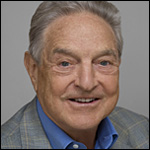
ohh…nice post but really?/? 😛